 Oil-
Oil-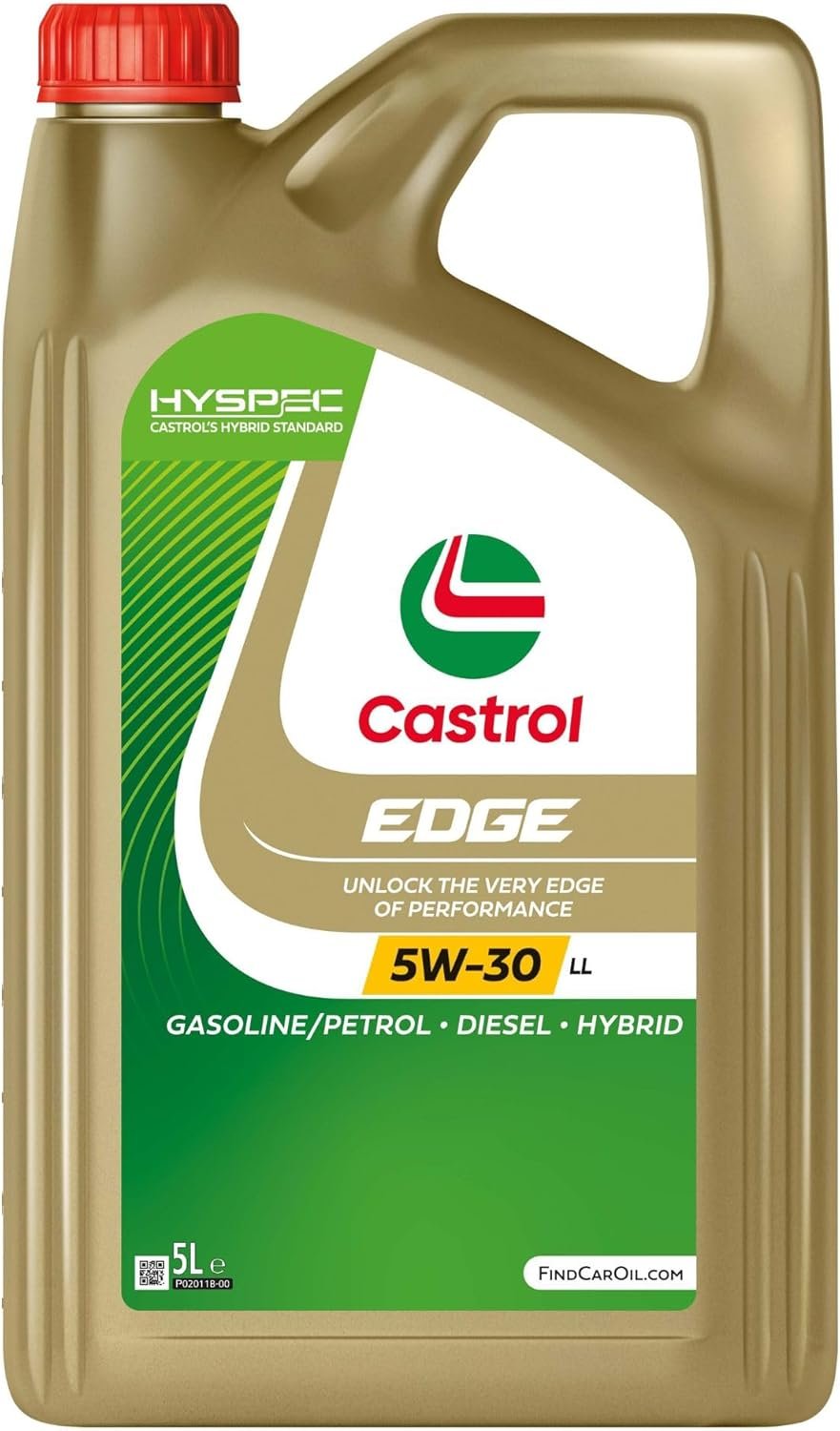
As an Amazon Associate, we may earn from qualifying purchases. This doesn't affect our recommendations — we only suggest oils that hold the exact OEM approval for your engine.
Best Engine Oil for BMW 320d G20 2.0 Diesel (190 HP) — B47D20
The seventh-generation BMW 3 Series (G20), launched in 2019, continues the nameplate’s long reign as the benchmark sports saloon. The 320d variant fitted with the B47D20 engine is comfortably the best-selling version in the UK, combining 190 HP and 400 Nm of torque with genuine 50-55 mpg fuel economy on a motorway run. The B47 is BMW’s second-generation modular four-cylinder diesel, a ground-up replacement for the troubled N47 that earned a fearsome reputation for rear-mounted timing chain failures. BMW addressed that problem decisively by moving the timing chain to the front of the engine, and the B47 has proven itself a far more reliable unit as a result. That said, the engine is not without its own weak points. EGR cooler failures, DPF clogging on city-driven cars, and premature electric water pump failures are all documented concerns that demand attention. Correct oil selection sits at the centre of preventive maintenance for every one of these issues. The B47D20 requires BMW Longlife-04 approved oil with ACEA C3 low-SAPS chemistry, and using anything else risks accelerating DPF deterioration and turbo wear. This guide covers the mandatory specifications, oil capacity, common failure points, and the four best oils for keeping your G20 320d running reliably for the long term.
Quick Answer: Recommended Oil
For BMW 3 Series G20 320d 2.0 Diesel (190 HP, B47D20):
- Recommended viscosity: SAE 5W-30 (alternative: 0W-30)
- Oil capacity: 5.2 litres with filter (4.8 L without)
- Required norms: ACEA C3, BMW Longlife-04
Key point: BMW LL-04 is the mandatory oil specification for all BMW diesel engines equipped with a diesel particulate filter. It mandates low-SAPS (Sulphated Ash, Phosphorus, Sulphur) additive chemistry that limits the non-combustible ash residue entering the DPF. Using a standard 5W-30 without LL-04 approval will accelerate ash loading in the filter, potentially triggering repeated forced regeneration cycles, reduced performance, and ultimately DPF replacement costing £1,500-2,500. Always verify the BMW LL-04 approval on the bottle before adding oil to a G20 320d.
The B47D20 Engine: BMW’s Modern Diesel
The B47 engine family represents BMW’s second generation of modular diesel engines, built on the same flexible architecture that underpins the B37 three-cylinder and B57 six-cylinder diesels. The B47D20 displaces 1,995cc from an aluminium block with a steel crankshaft, producing 190 HP at 4,000 RPM and a substantial 400 Nm of torque from just 1,750 RPM. This torque delivery gives the G20 320d a decisive, effortless character in everyday driving that makes it one of the most satisfying diesel saloons available.
Front-mounted timing chain. This is the single most significant improvement over the predecessor N47 engine, which mounted its timing chain at the rear of the engine between the block and the gearbox. The N47’s rear chain design meant that chain stretch — an inevitable consequence of high-mileage running — required gearbox removal for replacement, turning a routine maintenance item into a £2,000-3,000 repair. Worse, many N47 chains failed catastrophically before owners were aware of the problem, destroying valves and pistons. BMW’s decision to move the B47’s timing chain to the front of the engine means chain inspection and replacement is straightforward, and chain-related failures are dramatically less common. The B47’s chain is a conventional front-mounted design accessible without removing the transmission, and while it still requires monitoring at higher mileages, the failure rate is a fraction of the N47’s.
Variable geometry turbocharger. The B47D20 uses a single variable-geometry turbocharger that adjusts vane angle continuously to optimise boost delivery across the entire rev range. Peak boost arrives early and is sustained through to the redline, contributing to the engine’s flat, linear torque curve. The turbo’s journal bearings are pressure-fed with engine oil and rely entirely on oil quality for lubrication and cooling. Turbo wear accelerates significantly when oil changes are neglected, as degraded oil loses its ability to maintain a protective film at the extreme temperatures inside the turbo housing.
Exhaust aftertreatment. The G20 320d meets Euro 6d emissions standards through a combination of diesel particulate filter, diesel oxidation catalyst, and selective catalytic reduction using AdBlue. This multi-stage aftertreatment system is highly effective but makes the engine entirely dependent on low-SAPS oil to maintain DPF longevity.
Why BMW LL-04 Oil Is Non-Negotiable
BMW Longlife-04 is not a marketing label. It is a rigorous engineering specification that defines the chemical composition of the oil’s additive package, its viscosity behaviour, its soot-handling capability, and its ash output.
DPF protection through controlled ash. Every engine oil produces metallic ash as its additive package degrades during combustion. This ash cannot be burned off during DPF regeneration — it accumulates permanently, gradually reducing the filter’s capacity. LL-04 oils are formulated with strict limits on sulphated ash (below 0.8%), phosphorus, and sulphur, significantly reducing the rate of ash accumulation compared to conventional diesel oils. Over a typical 120,000-mile engine life, the difference between LL-04 oil and a non-approved alternative can mean the difference between a DPF that functions normally and one that requires replacement at £1,500-2,500.
Soot dispersancy under diesel conditions. The B47D20 generates substantial soot under load, particularly during cold starts and city driving where combustion temperatures are lower. LL-04 oils contain advanced dispersant additives specifically formulated to keep soot particles in suspension, preventing them from agglomerating into abrasive clusters that accelerate bearing wear and thicken the oil. Soot-laden oil that has exceeded its dispersant capacity becomes a grinding paste rather than a lubricant.
Turbo protection at shutdown. After sustained motorway driving, the turbocharger remains extremely hot when the engine is switched off. Oil trapped in the turbo bearing housing experiences a temperature spike as residual exhaust heat soaks through. If the oil has degraded, it cokes inside the housing, forming hard carbon deposits that restrict oil flow and score the shaft. High-quality LL-04 oil resists coking far more effectively than cheaper alternatives, protecting the turbo during this critical heat-soak period.
Technical Specifications: B47D20
| Specification | Value |
|---|---|
| Displacement | 1,995cc (2.0 litres) |
| Layout | Inline-4, longitudinal, aluminium block |
| Valvetrain | DOHC, 16 valves, front-mounted timing chain |
| Compression Ratio | 16.5:1 |
| Power | 190 HP @ 4,000 RPM |
| Torque | 400 Nm @ 1,750-2,500 RPM |
| Fuel System | Common-rail direct injection |
| Turbocharger | Variable geometry (VGT) |
| Emissions | Euro 6d with DPF, DOC, SCR (AdBlue) |
| Recommended Viscosity | SAE 5W-30 (alternative: 0W-30) |
| Oil Capacity (without filter) | 4.8 litres |
| Oil Capacity (with filter) | 5.2 litres |
| ACEA Norm | C3 |
| BMW Norm | BMW Longlife-04 |
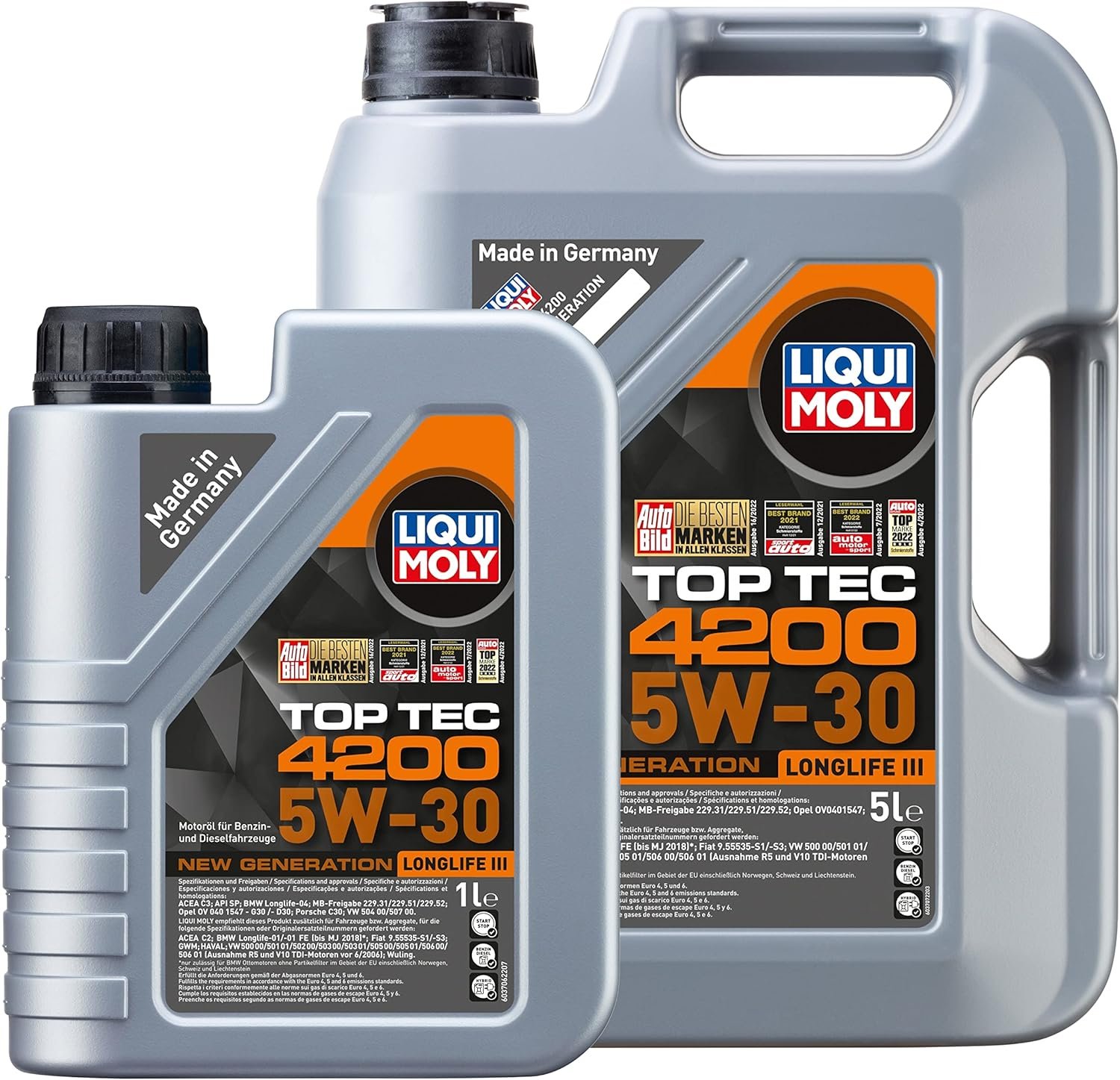
Best Value: Liqui Moly Top Tec 4200 5W-30 Liqui Moly’s German-engineered Top Tec 4200 delivers full BMW LL-04 compliance at the most competitive price point. A robust detergent package combats EGR-related carbon deposits, while effective soot dispersancy maintains oil cleanliness between services. The low-SAPS formulation protects the DPF without compromising on the film strength needed for turbo and bearing protection. Cold-start protection down to -30 degrees C ensures rapid oil flow to critical components on winter mornings. At £35-42 for 5 litres, it is the best balance of LL-04 compliance and affordability, making it an excellent choice for owners who maintain strict service intervals and want to minimise running costs without cutting corners on specification.
Oil Change Intervals
BMW Official Recommendation:
- Condition Based Service (CBS): up to 18,000 miles or 24 months
- The iDrive system monitors driving patterns and calculates remaining oil life
Recommended Practice: 10,000 miles or 12 months, whichever comes first.
BMW’s Condition Based Service system can suggest intervals up to 18,000 miles, but this assumes a significant proportion of motorway driving at steady loads where the engine reaches and maintains optimal operating temperature. For many UK owners who split their driving between commuting, school runs, and weekend motorway trips, the oil degrades faster than the CBS algorithm anticipates. Diesel engines impose harsher conditions on oil than petrol engines — soot loading, fuel dilution from DPF regeneration, and higher combustion pressures all accelerate oil degradation.
Consider 7,500-mile intervals if:
- Predominantly short trips under 15 miles (DPF cannot complete passive regeneration)
- Heavy urban stop-start driving (increased soot loading and fuel dilution)
- Vehicle exceeds 80,000 miles
- Oil level rises on the dipstick between services (fuel dilution from regen cycles)
- Any history of DPF warning lights or forced regeneration
- Towing or regular heavy loads
Always replace the oil filter at every oil change. The B47D20’s 5.2-litre capacity is generous for a four-cylinder engine, but diesel soot contamination and fuel dilution mean fresh filtration at every service is essential.
Common B47D20 Issues and Prevention
The B47D20 is fundamentally a robust engine that routinely reaches 120,000 miles and beyond without major issues when properly maintained. However, several documented weak points are worth understanding.
EGR cooler failure. The exhaust gas recirculation cooler is one of the most commonly reported failure points on the B47. The cooler develops internal cracks that allow coolant to leak into the intake manifold or exhaust system. Symptoms include unexplained coolant loss without visible external leaks, white smoke from the exhaust (coolant entering combustion chambers), and in severe cases, overheating. BMW issued recalls on certain production batches, and the issue has affected enough vehicles to be considered a known weakness of the B47 platform. If you notice coolant loss that cannot be explained by external leaks, have the EGR cooler inspected immediately. Replacement costs £600-1,200 depending on the workshop, but catching the failure early prevents the secondary damage — overheating, head gasket compromise, and catalytic converter contamination — that turns a manageable repair into a catastrophic one.
DPF clogging on city-driven cars. The diesel particulate filter requires sustained driving at motorway speeds to reach the 600 degrees C needed for passive soot regeneration. Cars driven predominantly in urban stop-start conditions never reach these temperatures, forcing the ECU into repeated active regeneration cycles that inject additional diesel fuel late in the combustion stroke. This fuel washes past the piston rings and dilutes the engine oil. A rising dipstick level between services is the telltale sign of fuel dilution. If active regeneration attempts repeatedly fail to complete, the DPF becomes progressively blocked, triggering warning lights, reduced power, and eventually limp mode. Prevention is straightforward: drive the car on a motorway or fast dual carriageway for at least 20-30 minutes once a week at speeds above 2,000 RPM. Professional DPF cleaning costs £300-500, while replacement runs to £1,500-2,500. BMW LL-04 oil is essential here — its low ash output slows DPF saturation significantly compared to non-approved alternatives.
Electric water pump premature failure. The B47D20 uses an electric water pump rather than a conventional belt-driven unit. This allows the ECU to control coolant flow independently of engine speed, improving warm-up times and thermal management. However, the electric pump has a documented failure pattern, typically between 60,000 and 80,000 miles. Symptoms include overheating warnings, fluctuating temperature gauge readings, and reduced heater output. The pump itself costs £200-400 for the part, with labour adding another £150-300. While not directly oil-related, a failing water pump causes overheating that degrades engine oil rapidly and can lead to head gasket damage if ignored.
Turbo wear from neglected oil changes. The variable-geometry turbocharger is generally reliable when serviced correctly, but neglected oil changes accelerate wear on the turbo’s journal bearings and can cause carbon deposits to build up on the variable vanes, causing them to stick. Symptoms include intermittent boost loss, turbo whistle that changes character, and reduced power. Quality LL-04 oil changed at sensible intervals keeps the turbo bearings lubricated and resists the coking that causes vane sticking. Turbo replacement on the G20 320d costs £1,200-2,000, making regular oil changes the most cost-effective insurance available.
Why 5W-30 and ACEA C3
BMW specifies 5W-30 as the primary viscosity for the B47D20, with 0W-30 as an acceptable alternative for colder climates. The 5W cold-start grade provides rapid oil flow to the turbo bearings, camshaft, and hydraulic lifters within seconds of ignition, while the 30 hot rating maintains adequate film thickness at operating temperature under the sustained high loads that a modern turbodiesel produces.
ACEA C3 is a mid-SAPS specification that balances emissions system protection with the robust additive package needed for diesel engine durability. Unlike the lower-SAPS ACEA C2, C3 allows a slightly higher ash content that provides stronger wear protection for the heavily loaded bearings and timing chain in the B47. BMW chose C3 rather than C2 because the B47’s bearing clearances and DPF design are engineered around this specific balance point. Do not substitute an ACEA C2 oil unless it also carries the BMW LL-04 approval — the reduced additive content may compromise wear protection under the loads this engine generates.
Conclusion
The BMW G20 320d with the B47D20 engine requires SAE 5W-30 engine oil meeting ACEA C3 and BMW Longlife-04 specifications, with a capacity of 5.2 litres including the filter. The B47 is a substantially more reliable engine than the N47 it replaced, thanks primarily to the front-mounted timing chain that eliminates the catastrophic chain failures that plagued the earlier unit. With correct maintenance, 120,000 miles and beyond is entirely realistic.
Castrol EDGE Professional LL 04 5W-30 is the natural OEM choice at £45-55 for 5 litres, while Liqui Moly Top Tec 4200 5W-30 offers the best value at £35-42 without compromising on the LL-04 specification. Change the oil at 10,000-mile intervals or annually regardless of what BMW’s CBS system suggests, shortening to 7,500 miles for predominantly urban driving. Watch for EGR cooler coolant leaks, keep the DPF healthy with regular motorway runs, and monitor the electric water pump from 60,000 miles onward. The B47D20 rewards disciplined ownership with years of refined, economical service — feed it the correct LL-04 oil at sensible intervals, and the most expensive repairs on this engine become unlikely rather than inevitable.
Our Top Picks
As an Amazon Associate, we may earn from qualifying purchases. This doesn't affect our recommendations — we only suggest oils that hold the exact OEM approval for your engine.