Best Engine Oil for VW Tiguan Mk2 1.4 TSI 125/150 HP
The Volkswagen Tiguan Mk2 with the 1.4 TSI EA211 ACT engine (2016-2018) represents VW’s deployment of their advanced turbocharged four-cylinder into compact SUV duty—significantly more demanding than the Golf hatchback design intent. With curb weights reaching 1,515-1,685 kg versus Golf’s 1,270-1,330 kg (200-355 kg heavier), this 1,395cc engine delivering 125-150 HP faces higher thermal and mechanical stresses managing SUV duties: family transport, occasional towing, sustained motorway cruising with increased drag, urban stop-start cycling with greater mass. Understanding critical VW 504 00/507 00 oil specification, recognizing shortened service intervals necessitated by SUV stress, managing carbon accumulation potentially accelerated by low-RPM high-load operation, and appreciating ACT cylinder deactivation challenged by increased weight enables owners to maximize reliable service this capable yet heavily loaded EA211 delivers with appropriate 5W-30 synthetic oil at conservative intervals.
Quick Answer: Recommended Oil
For Tiguan Mk2 1.4 TSI (both variants):
- Required viscosity: SAE 5W-30 (mandatory for VW specification)
- VW specification: 504 00/507 00 (essential for GPF and timing belt protection)
- ACEA specification: C3 (mid-SAPS for GPF compatibility)
- Oil capacity: 4.0 liters with filter
- Recommended oils:
- Castrol Edge Professional 5W-30 LL (VW 504 00/507 00 approved)
- Mobil 1 ESP Formula 5W-30 (Superior thermal stability for SUV loads)
- Shell Helix Ultra Professional AM-L 5W-30 (OEM quality)
- TotalEnergies Quartz Ineo Long Life 5W-30 (Value quality)
SUV Application Focus: The 1.4 TSI in Tiguan duty requires conservative maintenance acknowledging higher loads versus car applications. Oil changes at 10,000-12,000 km (shortened from Golf’s 12,000-15,000 km), timing belt inspection starting 100,000 km despite “lifetime” claims, walnut blasting carbon removal potentially earlier (50,000-70,000 km vs 60,000-80,000 km in cars) due to frequent low-RPM high-load operation, and driving techniques minimizing ACT stress (avoiding excessive low-RPM acceleration with 1,515+ kg) prove essential for long-term reliability in this challenging SUV application where a small-displacement engine manages substantial mass.
The 1.4 TSI EA211 ACT Engine (SUV Application)
The 1.4 TSI EA211 ACT in Tiguan Mk2 represents VW’s strategic deployment of their efficiency-focused engine into compact SUV duty—substantially more demanding than Golf applications. With 1,395cc displacement producing 125-150 HP and 200-250 Nm managing 1,515-1,685 kg (FWD to AWD), this turbocharged four-cylinder faces thermal and mechanical stresses approximating larger engines in lighter vehicles.
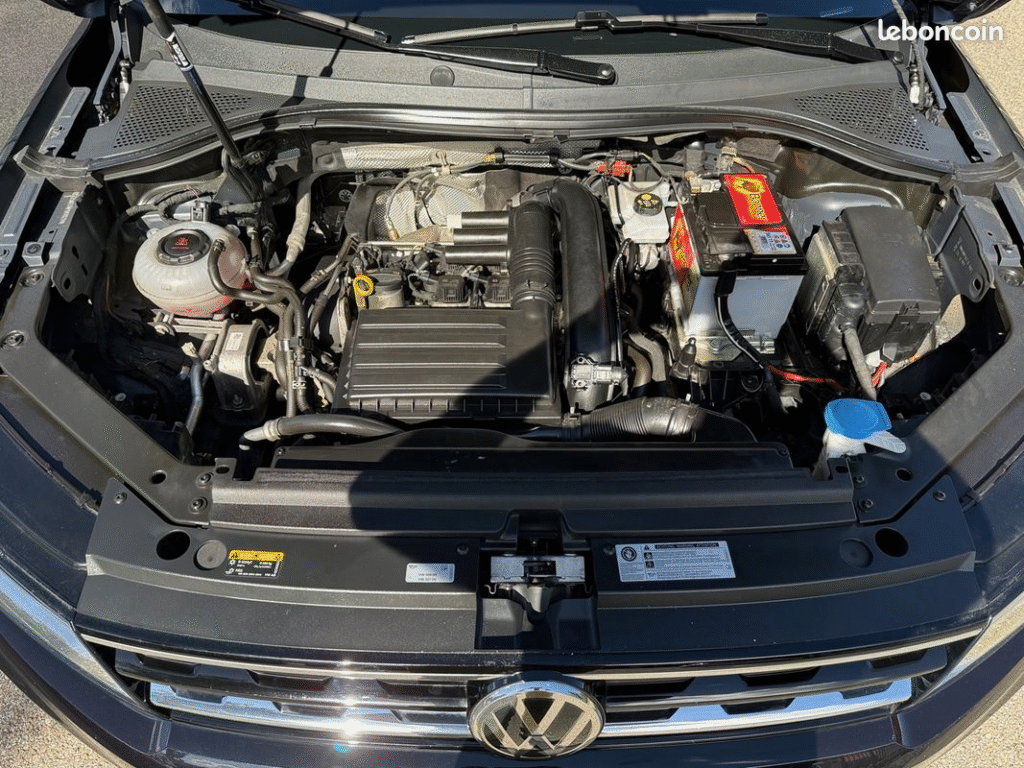
Technical Foundation: Aluminum block with cast-iron liners, DOHC head with integrated exhaust manifold, Bosch direct injection, turbocharger, oil-lubricated timing belt, ACT cylinder deactivation (cylinders 2 and 3), GPF integration.
SUV Challenges: Tiguan’s 200-355 kg weight penalty creates distinct operational patterns—higher average engine load, more frequent low-RPM high-load operation, increased thermal stress, reduced ACT effectiveness (heavier vehicle less suited to 2-cylinder operation), greater aerodynamic drag, more demanding stop-start cycling.
ACT in SUV Context: Cylinder deactivation proves less effective in SUV applications. The 1,515+ kg mass limits 2-cylinder operation opportunities—engine must reactivate sooner during acceleration, operates at higher individual cylinder loads when deactivated, experiences more frequent switching cycles.
Technical Specifications by Power Output
1.4 TSI 125 HP (92 kW) – Code CZCA (presumed):
Power 125 HP @ 5,000-6,000 RPM, torque 200 Nm @ 1,500-4,000 RPM, 0-100 km/h 10.9s (FWD manual), top speed 188 km/h, fuel economy 5.9-6.3 L/100 km combined (134-143 g/km CO2). FWD only, 6-speed manual or 7-speed DSG. Weight 1,515-1,565 kg. Adequate for unloaded urban/motorway operation, challenged by loaded acceleration or towing.
1.4 TSI 150 HP (110 kW) – Code CZDA/CZEA:
Power 150 HP @ 5,000-6,000 RPM, torque 250 Nm @ 1,500-4,500 RPM, 0-100 km/h 9.2s (FWD manual), 10.1s (AWD), top speed 202 km/h, fuel economy 5.8-6.5 L/100 km (131-148 g/km CO2). Available FWD or AWD (4Motion), 6-speed manual or 7-speed DSG. Weight 1,540-1,685 kg (AWD heaviest). More suitable for loaded SUV operation, AWD adds 100-120 kg but provides traction advantage.
Oil Requirements (Both Variants):
Viscosity SAE 5W-30 only, VW 504 00/507 00 mandatory, capacity 4.0 liters with filter, ACEA C3, recommended intervals 10,000-12,000 km (shortened from VW official 15,000 km acknowledging SUV stress).
Both variants share identical architecture and ACT technology. The 150 HP’s additional 50 Nm torque (250 vs 200 Nm) proves particularly valuable in SUV applications—the extra torque enables more relaxed operation under load, reducing thermal stress during acceleration and improving overtaking confidence when loaded or towing.
Oil Specification: VW 504 00/507 00 (SUV Application)
VW 504 00/507 00 represents Volkswagen’s low-SAPS specification for turbocharged engines with GPF—particularly critical for the 1.4 TSI managing higher sustained loads in Tiguan duty.
ACEA C3 Rating: Mid-SAPS formulation providing robust wear protection essential for SUV application. Tiguan’s higher loads create increased bearing stress, elevated oil temperatures, more demanding turbocharger operation.
5W-30 Viscosity Critical: Excellent cold-start protection for ACT, adequate high-temperature film strength for loaded operation, fuel economy contribution, optimal turbocharger bearing protection, timing belt lubrication compatibility. Particularly important in SUV applications—thinner oils might compromise protection under sustained loads, thicker oils reduce fuel economy and ACT effectiveness.
Timing Belt Protection (SUV Loads): Oil-lubricated timing belt experiences higher stresses in Tiguan versus Golf. Increased loads translate to higher belt tension, elevated oil temperatures, more frequent load cycling. Quality VW 504 00/507 00 oil at shortened intervals (10,000-12,000 km) maintains proper belt lubrication.
Reduced Capacity (4.0 Liters): Smaller capacity creates challenges in SUV applications. Adequate but not generous thermal capacity, moderate contaminant dilution requiring shortened service intervals, sufficient for ACT operation. Reduced capacity justifies conservative 10,000-12,000 km intervals in demanding SUV duty.
Top Oil Recommendations (SUV Application Priority)
Best for SUV Loads: Mobil 1 ESP Formula 5W-30
Meets VW 504 00/507 00 with exceptional thermal stability for sustained high-load SUV operation. Superior shear stability maintains viscosity under the Tiguan’s demanding conditions—particularly important for AWD variants experiencing higher drivetrain stresses. Robust turbocharger protection under sustained boost. Premium choice justifying slightly higher cost in demanding applications. Cost: £50-65/5L.
Best Value: Castrol Edge Professional 5W-30 LL
VW 504 00/507 00 approved formulation specifically engineered for VW Group engines. Proven protection for ACT systems under varying loads. Widely available, reasonable pricing for 4.0L capacity. Adequate for typical SUV operation including light towing and family transport. Cost: £45-58/5L.
OEM Quality: Shell Helix Ultra Professional AM-L 5W-30
VW 504 00/507 00 approved offering proven GPF protection and reliable performance. Formulation used in VW workshops globally. Adequate protection for normal SUV driving patterns across both power variants. Cost: £43-55/5L.
Value Quality: TotalEnergies Quartz Ineo Long Life 5W-30
ACEA C3 approved providing solid performance for 10,000-12,000 km intervals. Adequate protection at mid-range pricing. Suitable for predominantly urban/motorway operation without frequent towing or maximum loads. Cost: £38-48/5L.
Oil Change Intervals & Service Schedule
VW Official: 15,000 km or 12 months
Recommended Practice (SUV Application): 10,000-12,000 km or annually
SUV-Specific Interval Reduction:
- Primarily urban driving: 10,000 km
- Mixed urban/motorway: 10,000-12,000 km
- Predominantly motorway: 12,000 km maximum
- Any towing operation: 10,000 km
- AWD variants: 10,000-11,000 km
- Always annually regardless of mileage
Why Shortened Intervals? The Tiguan’s 200-355 kg weight penalty creates substantially higher thermal and mechanical stresses versus Golf applications. Higher average engine loads increase oil temperature and oxidation rates, more frequent low-RPM high-load operation increases fuel dilution and combustion byproduct accumulation, reduced 4.0L capacity provides less contaminant dilution buffer, ACT operation under varying loads creates unique thermal cycling patterns, timing belt oil lubrication demands consistent quality protection. These factors justify conservative 10,000-12,000 km intervals ensuring adequate protection under SUV stresses.
Regular Maintenance Requirements
Timing Belt Service (SUV Perspective)
VW Official: “Lifetime” or 150,000 miles (240,000 km)
SUV Reality: Inspect 100,000 km, consider replacement by 150,000 km. Timing belt experiences higher stresses in Tiguan versus Golf due to increased loads. ACT system complicates service requiring specialized diagnostic equipment (£1,500-2,000). Cost: £600-1,000 including water pump. Service components: timing belt, water pump, coolant flush, ACT calibration.
Carbon Buildup Management (Potentially Accelerated)
DI Challenge: Direct injection accumulates carbon on intake valves. Symptoms: rough idle, hesitation, reduced power.
SUV Factor: Frequent low-RPM high-load operation (typical SUV driving) potentially accelerates carbon formation. Budget for walnut blasting 50,000-70,000 km versus 60,000-80,000 km in lighter vehicles. Service: £300-500. Prevention: regular motorway driving (sustained higher RPM), periodic “Italian tune-up” (5-10 minutes at 4,000-5,000 RPM), quality fuel additives every 3,000-5,000 km.
ACT System & Additional Maintenance
ACT Characteristics: Subtle vibration when switching modes, distinctive “boom” reactivating cylinders, hesitation 1,200-2,000 RPM. May prove more pronounced in SUV due to higher mass. Software updates: VW released multiple ECU calibrations—ensure latest installed. SUV driving techniques: avoid aggressive low-RPM acceleration, anticipate acceleration needs, gentle throttle during urban operation, consider disabling ACT during towing.
GPF & Turbocharger: Quality VW 504 00/507 00 oil at 10,000-12,000 km intervals extends GPF life beyond 150,000 km. Turbocharger operates at higher boost more frequently managing Tiguan’s mass. Replacement £700-1,000 if catastrophic failure. Prevention: Quality oil, proper warm-up/cool-down.
Additional Services: Spark plugs 50,000-60,000 km (increased loads and ACT demand fresh plugs), DSG transmission 60,000 km (experiences higher thermal loads managing Tiguan’s mass—particularly AWD variants).
125 HP vs 150 HP: SUV Application Perspective
125 HP (200 Nm): Adequate for unloaded operation, challenged by loaded acceleration, insufficient for towing, best fuel economy (5.9-6.3 L/100 km), FWD only. Suitable for solo/couple use with minimal loads—not ideal for family SUV duty.
150 HP (250 Nm): More suitable for loaded SUV operation, extra 50 Nm provides relaxed loaded acceleration, adequate for light towing (up to 1,500 kg), available AWD improves traction (adds 100-120 kg), moderate economy penalty (5.8-6.5 L/100 km). Recommended for typical family SUV use.
Maintenance: Both require identical service—same shortened oil intervals (10,000-12,000 km), same timing belt attention, same carbon management. The 150 HP’s additional torque reduces thermal stress during loaded operation—engine doesn’t work as hard achieving same performance. AWD variants (150 HP): additional 100-120 kg plus AWD drivetrain losses increase thermal stresses—conservative 10,000-11,000 km oil intervals particularly important.
Maximizing Tiguan Mk2 1.4 TSI Longevity
Essential Maintenance (SUV-Specific): VW 504 00/507 00 oil at 10,000-12,000 km (shortened acknowledging SUV loads), timing belt inspection 100,000 km (consider replacement by 150,000 km), walnut blasting 50,000-70,000 km, spark plugs 50,000-60,000 km, DSG service 60,000 km, software updates for ACT, quality fuel exclusively.
SUV Best Practices: Avoid aggressive low-RPM acceleration (challenges small engine with 1,515+ kg), allow extended warm-up before heavy loading, anticipate acceleration needs (minimizes full-throttle demands), regular motorway driving (supports carbon management and GPF), monitor oil level regularly, service AWD system per schedule.
Reality of Small Engine in SUV: The 1.4 TSI proves capable in Tiguan duty when properly maintained and driven sympathetically. However, understand limitations: this engine excels in lighter vehicles (Golf), operates near design limits in SUV applications, requires conservative maintenance acknowledging higher stresses, benefits from driving techniques minimizing low-RPM high-load operation. Realistic expectations and appropriate maintenance enable 150,000-200,000 km service life—aggressive driving or neglected maintenance accelerates wear substantially.
Conclusion
The Volkswagen Tiguan Mk2 1.4 TSI (125/150 HP) requires VW 504 00/507 00 approved SAE 5W-30 oil meeting ACEA C3 specification with 4.0-liter capacity for optimal protection in demanding SUV applications where a small-displacement engine manages substantial mass.
Choose oils prioritizing thermal stability: Mobil 1 ESP Formula (best for SUV loads), Castrol Edge Professional LL (best value), Shell Helix Ultra Professional AM-L (OEM quality), or TotalEnergies Quartz Ineo Long Life (value quality). Verify VW 504 00/507 00 approval.
SUV Application Realism: The 1.4 TSI EA211 ACT delivers impressive efficiency (5.8-6.5 L/100 km) and adequate performance (9.2-10.9s 0-100 km/h) in Tiguan duty, but owners must acknowledge this engine operates near design limits managing 1,515-1,685 kg. Shortened oil intervals (10,000-12,000 km vs 15,000 km in cars), potentially earlier carbon service (50,000-70,000 km), timing belt attention despite “lifetime” claims, and sympathetic driving minimizing low-RPM high-load operation prove essential for long-term reliability.
When maintained conservatively with VW 504 00/507 00 specification oil at SUV-appropriate intervals, timing belt inspection/service, proactive carbon management, and driving techniques respecting the engine’s displacement limitations, the Tiguan Mk2 1.4 TSI delivers reliable SUV service—proving that modern small-displacement turbocharged engines achieve adequate longevity in heavier applications when owners understand their unique maintenance requirements and operational limitations rather than treating them as larger-displacement engines requiring conventional service approaches.