
Best Engine Oil for Ford Kuga Mk2 2.0 TDCi 150/180 HP
The Ford Kuga Mk2 with the 2.0 TDCi Duratorq diesel engine (2013-2019) represents Ford’s workhorse diesel offering for compact SUV applications, delivering substantial torque (370-400 Nm) with strong towing capability and impressive fuel economy (4.7-5.7 L/100 km). Available in 150 HP and 180 HP outputs across FWD and AWD configurations, this robust four-cylinder turbocharged diesel combines proven common-rail injection, timing belt drive, and comprehensive DPF/EGR emissions compliance. Understanding the correct Ford WSS-M2C950-A oil specification, managing predictable diesel maintenance requirements including fuel injector service and EGR valve attention, and recognizing the engine’s moderate oil capacity (5.8 liters) enables owners to maximize the reliable long-term operation this proven diesel powerplant delivers when maintained according to Ford’s comprehensive service schedule for demanding SUV applications.
Quick Answer: Recommended Oil
For Kuga Mk2 2.0 TDCi (both variants):
- Required viscosity: SAE 0W-30 (mandatory for DPF protection)
- Ford specification: WSS-M2C950-A (low-SAPS, DPF compatible)
- ACEA specification: C2 (mid-SAPS diesel formulation)
- Oil capacity: 5.8 liters with filter
- Recommended oils:
- Castrol Magnatec Stop-Start D 0W-30 (WSS-M2C950-A)
- Mobil Super 3000 Formula F 0W-30 (Ford approved)
- Shell Helix Ultra Professional AJ-L 0W-30 (OEM quality)
- TotalEnergies Quartz Ineo FDE 0W-30 (Value quality)
SUV Application Focus: This engine emphasizes regular scheduled maintenance over critical emergency interventions. Timing belt service at 150,000 km intervals (with water pump), fuel injector attention around 120,000-150,000 km, EGR valve cleaning 80,000-120,000 km, and quality Ford WSS-M2C950-A oil at 12,000-15,000 km intervals support long-term reliability. The Kuga’s SUV application—higher vehicle weight (1,600-1,750 kg), towing capability (up to 2,100 kg), and AWD torque distribution—increases thermal stress versus car applications, making consistent maintenance particularly important.
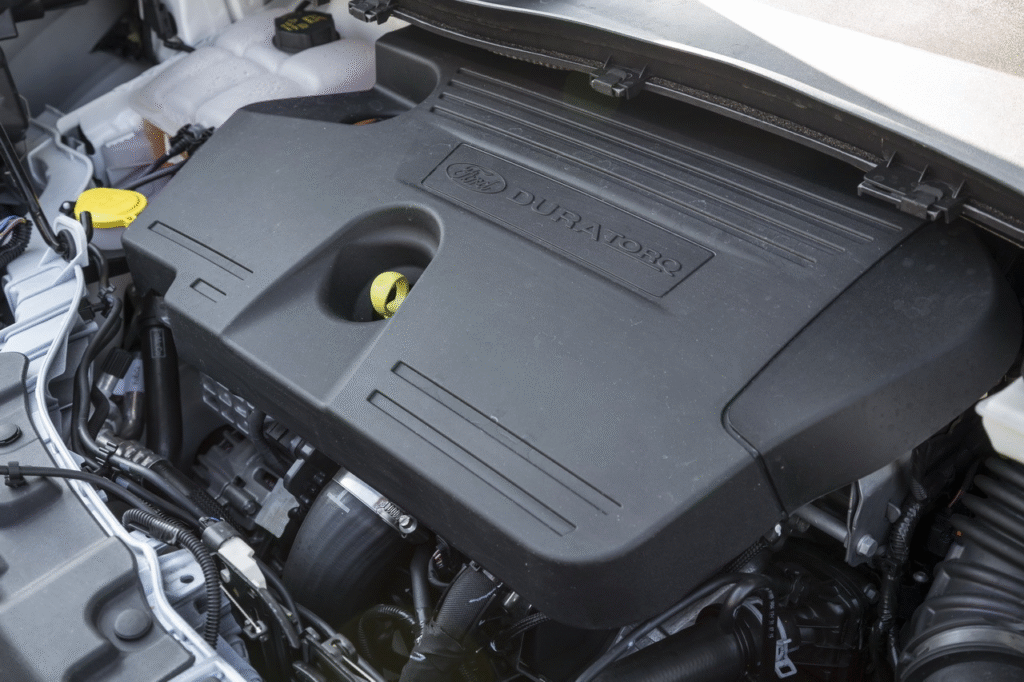
The 2.0 TDCi Duratorq Engine (SUV Application)
The 2.0 Duratorq TDCi in the Kuga Mk2 represents Ford’s proven workhorse diesel adapted for compact SUV duty. With 1,997cc displacement across four cylinders, this turbocharged diesel delivers substantial low-end torque (370-400 Nm) suitable for the Kuga’s SUV mission: towing trailers, carrying loads, navigating varied terrain (AWD variants), and sustained motorway cruising with family and luggage.
Technical Foundation: Cast-iron cylinder block (robust construction), 16-valve DOHC aluminum cylinder head, Bosch common-rail direct injection system, variable geometry turbocharger (VGT), intercooler integration, timing belt drive system, DPF and EGR emissions compliance (Euro 5/6).
SUV-Specific Demands: The Kuga application places higher demands versus car installations: increased vehicle weight (1,600-1,750 kg vs Focus 1,400 kg), substantial towing capability (up to 2,100 kg braked), AWD torque distribution (180 HP variant primarily AWD), higher center of gravity requiring more suspension damping, frequent urban/motorway transitions.
Technical Specifications by Power Output
2.0 TDCi 150 HP (110 kW):
- Engine code: T7CA, T7CB, T7CC
- Production: 2013-2019 (Kuga Mk2)
- Configuration: Inline-4, cast-iron block, 16-valve DOHC
- Power: 150 HP (110 kW) @ 3,500 RPM
- Torque: 370 Nm (273 lb-ft) @ 2,000-2,500 RPM
- 0-100 km/h: 10.1 seconds (FWD manual)
- Top speed: 194 km/h
- Fuel economy: 4.7-5.0 L/100 km combined (124-131 g/km CO2)
- Transmission: 6-speed manual (FWD/AWD) or PowerShift automatic (AWD)
- Weight: 1,600-1,700 kg depending on drivetrain
- Towing capacity: Up to 2,100 kg (braked)
2.0 TDCi 180 HP (132 kW):
- Engine code: T8CA, T8CB, T8MA
- Production: 2013-2019 (Kuga Mk2)
- Configuration: Inline-4, cast-iron block, 16-valve DOHC
- Power: 180 HP (132 kW) @ 3,500 RPM
- Torque: 400 Nm (295 lb-ft) @ 2,000-2,500 RPM
- 0-100 km/h: 8.9 seconds (AWD manual), 9.4 seconds (AWD PowerShift)
- Top speed: 200 km/h
- Fuel economy: 5.2-5.7 L/100 km combined (137-149 g/km CO2)
- Transmission: 6-speed manual or PowerShift automatic (AWD primarily)
- Weight: 1,650-1,750 kg (AWD configuration)
- Towing capacity: Up to 2,100 kg (braked)
Oil Requirements (Both Variants):
- Viscosity: SAE 0W-30 only
- Specification: Ford WSS-M2C950-A
- Capacity: 5.8 liters with filter
- Filter: Motorcraft or equivalent
- ACEA rating: C2 (low-SAPS)
- Intervals: 12,000-15,000 km or annually
Both power variants share identical architecture and maintenance requirements. The 180 HP achieves higher output through optimized turbocharger calibration (increased VGT boost) and modified ECU mapping. The substantial torque difference (370 vs 400 Nm) makes the 180 HP more suitable for frequent towing or heavily loaded SUV operation.
Oil Specification: Ford WSS-M2C950-A
Ford WSS-M2C950-A represents Ford’s diesel engine oil specification for DPF-equipped engines, balancing adequate wear protection with emissions system longevity—particularly important for SUV applications with higher loads.
ACEA C2 Rating: Mid-SAPS formulation providing higher HTHS (High Temperature High Shear) viscosity than ultra-low-SAPS specifications. This robust protection proves critical for the Kuga’s demanding SUV application: sustained towing at motorway speeds, AWD torque distribution creating additional thermal stress, higher vehicle weight increasing load on drivetrain components.
0W-30 Viscosity Benefits: Excellent cold-start protection (critical for diesel engines), adequate high-temperature film strength for sustained loaded operation, fuel economy contribution through reduced friction, optimal flow to VGT turbocharger bearings, compatibility with DPF regeneration cycles.
Moderate Oil Capacity (5.8 Liters): The Kuga’s 5.8L capacity falls between smaller diesels (1.5 TDCi: 4.25L) and larger applications (Focus 2.0 TDCi: 7.2L). This moderate capacity provides: adequate thermal capacity for SUV operation, reasonable contaminant dilution capability, sufficient lubrication reserve for turbocharger protection, acceptable fuel dilution tolerance during DPF regeneration.
DPF Protection: Low-SAPS content prevents DPF ash accumulation requiring expensive replacement (£800-1,200) or professional cleaning (£300-500). The C2 specification balances adequate wear protection with DPF longevity across extended service intervals—essential for high-mileage SUV use including frequent motorway cruising where DPF regeneration occurs naturally.
Top Oil Recommendations
Best Overall: Castrol Magnatec Stop-Start D 0W-30
Ford WSS-M2C950-A approved formulation specifically engineered for modern diesel engines with DPF. Enhanced protection during frequent stop-start operation common in urban SUV driving. Proven in Ford service networks. Excellent value for 5.8L capacity. Cost: £45-60/5L.
High-Performance Choice: Mobil Super 3000 Formula F 0W-30
Meets Ford WSS-M2C950-A with exceptional thermal stability for sustained motorway cruising, towing applications, and AWD operation where the Kuga excels. Superior shear stability maintains viscosity through extended 15,000 km intervals. Robust turbocharger protection under sustained boost. Cost: £48-62/5L.
OEM Quality: Shell Helix Ultra Professional AJ-L 0W-30
Ford WSS-M2C950-A approved offering proven DPF protection and cleanliness. Formulation used in Ford workshops globally. Adequate protection for normal SUV driving patterns across both power variants. Cost: £43-56/5L.
Value Quality: TotalEnergies Quartz Ineo FDE 0W-30
ACEA C2 approved providing solid performance for 12,000-15,000 km intervals. Adequate DPF protection and wear characteristics at mid-range pricing. Widely available. Cost: £40-50/5L.
Oil Change Intervals & Service Schedule
Ford Official: 15,000 km or 12 months
Recommended Practice: 12,000-15,000 km or annually
Interval Considerations (SUV Application):
- Primarily urban driving with frequent DPF regeneration: 12,000 km
- Mixed urban/motorway driving: 12,000-13,000 km
- Predominantly motorway use: 13,000-15,000 km
- Towing or commercial use: 12,000 km maximum
- AWD operation (180 HP primarily): 12,000-13,000 km
- Always annually regardless of mileage
SUV-Specific Considerations: The Kuga’s higher vehicle weight, towing capability, and AWD torque distribution increase thermal stress versus car applications. While the 5.8L capacity provides adequate contaminant dilution for standard intervals, frequent towing or heavy loading warrants shortened 12,000 km intervals ensuring optimal protection under sustained high-load operation.
Regular Maintenance Requirements
Timing Belt Service (150,000 km / 10 Years)
Complete Service: Timing belt, tensioner/idler pulleys, water pump (belt-driven), auxiliary belt if worn, coolant flush/refill. Professional installation with proper locking tools. Cost: £500-750.
The 2.0 TDCi typically reaches manufacturer intervals without premature failure when maintained properly.
Fuel Injector & EGR Maintenance
Fuel Injectors (120,000-150,000 km): Quality diesel fuel and regular filter changes (every 10,000-12,000 km) essential. Symptoms: rough idle, misfires, black smoke. Service: Professional cleaning £200-400, replacement £600-1,000 complete set.
EGR Valve (80,000-120,000 km): Carbon buildup common with urban SUV use. Symptoms: rough idle, hesitation, black smoke. Service: Professional cleaning £150-300, replacement £300-600. Prevention: Regular motorway driving, quality fuel.
DPF & Turbocharger Care
DPF Management: Weekly motorway driving (20+ km at 80+ km/h) for passive regeneration. The Kuga’s SUV mission often includes motorway cruising naturally supporting DPF regeneration. Professional cleaning £300-500, replacement £800-1,200 if severely clogged.
Turbocharger: VGT turbocharger requires clean oil. VGT actuator failure £200-400, complete turbo replacement £800-1,200+. Prevention: Quality oil, 30-60 seconds warm-up after cold starts, prompt oil leak repair.
150 HP vs 180 HP: Choosing Your Variant
150 HP Characteristics: Adequate torque (370 Nm) for light-moderate towing, available FWD (best economy) or AWD, 6-speed manual or PowerShift automatic, best fuel economy (4.7-5.0 L/100 km), lower weight (1,600-1,700 kg), ideal for non-towing SUV use.
180 HP Characteristics: Maximum torque (400 Nm) for frequent towing or heavy loading, primarily AWD configuration with 6-speed manual or PowerShift automatic, enhanced performance (8.9s 0-100 AWD), moderate economy penalty (5.2-5.7 L/100 km), heavier (1,650-1,750 kg AWD), most versatile for demanding SUV applications.
Maintenance Perspective: Both share identical service requirements—same timing belt schedule, same injector/EGR/turbocharger maintenance, same oil specification. The 180 HP AWD experiences higher thermal stress from increased torque and AWD operation, making consistent 12,000-13,000 km oil intervals particularly important versus potentially stretching to 15,000 km with lighter 150 HP FWD usage.
Towing Considerations: Both variants offer identical 2,100 kg braked towing capacity. However, the 180 HP’s additional 30 Nm torque (400 vs 370 Nm) provides more relaxed towing performance, particularly on gradients or during overtaking maneuvers—important for confident family towing.
Maximizing Kuga Mk2 2.0 TDCi Longevity
Essential Maintenance:
- Ford WSS-M2C950-A oil at 12,000-15,000 km (12,000 km for towing/AWD)
- Timing belt service 150,000 km (comprehensive with water pump)
- Fuel injector attention 120,000-150,000 km
- EGR valve cleaning 80,000-120,000 km
- OEM fuel filter every 10,000-12,000 km
- Quality diesel fuel exclusively
- Weekly motorway driving for DPF regeneration
- Turbocharger proper warm-up and cool-down
SUV-Specific Best Practices:
- Monitor oil level regularly (particularly with towing/AWD operation)
- Allow extended warm-up before heavy loading or towing
- Avoid aggressive driving when heavily loaded (stress on drivetrain)
- Service AWD system per Ford schedule (transfer case, PTU, rear differential)
- Inspect suspension components regularly (higher loads versus cars)
Long-Term Reliability: The 2.0 TDCi proves fundamentally robust in SUV applications when comprehensive maintenance schedules are followed. Many taxi operators and high-mileage users (including Kuga Mk2 owners) report 200,000-300,000 km operation with scheduled component replacement rather than catastrophic failures. The key: consistent maintenance rather than reactive repairs, with particular attention to oil quality and intervals when towing or using AWD frequently.
Conclusion
The Ford Kuga Mk2 2.0 TDCi (150/180 HP) requires Ford WSS-M2C950-A approved SAE 0W-30 oil meeting ACEA C2 specification with 5.8-liter capacity for optimal protection and DPF longevity in demanding SUV applications.
Choose proven oils: Castrol Magnatec Stop-Start D, Mobil Super 3000 Formula F, Shell Helix Ultra Professional AJ-L, or TotalEnergies Quartz Ineo FDE. Verify Ford WSS-M2C950-A or ACEA C2 approval.
SUV Application Excellence: The 2.0 TDCi achieves long-term reliability through comprehensive scheduled maintenance. Timing belt at 150,000 km, fuel injector service 120,000-150,000 km, EGR cleaning 80,000-120,000 km, and quality oil at appropriate intervals (12,000 km for towing/AWD operation) enable 200,000+ km service life. Understanding this engine’s predictable maintenance requirements—fuel system attention, emissions component service, proper lubrication—enables confident long-term SUV ownership.
When maintained comprehensively with correct Ford WSS-M2C950-A specification oil and scheduled component service, the Kuga Mk2 2.0 TDCi delivers substantial torque (370-400 Nm), impressive fuel economy (4.7-5.7 L/100 km), capable towing performance (2,100 kg braked), and reliable high-mileage operation for demanding SUV users including families requiring space and capability, frequent towers requiring confidence and capacity, and high-mileage motorway drivers seeking diesel economy with SUV practicality.