
Best Engine Oil for Ford Fiesta Mk7 1.0 L EcoBoost
The Ford Fiesta 1.0 EcoBoost represents a revolutionary milestone in small-displacement turbocharged engine technology, dominating UK sales charts throughout the 2010s. This award-winning three-cylinder powerplant delivers 100-140 horsepower from just 999cc while achieving remarkable fuel economy of 55-65 mpg. Understanding proper oil specifications for this innovative engine proves absolutely critical for longevity, as the 1.0 EcoBoost incorporates unique technologies including a wet timing belt running in oil that demand specific lubrication for reliable operation. With over 700,000 vehicles equipped with this engine in the UK alone, proper maintenance knowledge ensures these efficient engines deliver trouble-free service.
The 1.0 EcoBoost Engine: Award-Winning Innovation
The 1.0 EcoBoost debuted in 2012, winning an unprecedented six consecutive International Engine of the Year awards in the sub-1.0-litre category. Developed at Ford’s Dunton Technical Centre in Essex, this engine proved that small displacement combined with turbocharging could match larger naturally aspirated engines while dramatically reducing fuel consumption and emissions.
The engine features a cast iron block—unusual for modern engines but chosen because iron heats faster than aluminium, reducing cold-start emissions and improving warm-up times. At just 97kg and fitting on an A4 sheet of paper, the 1.0 EcoBoost represents extraordinary packaging efficiency. The three-cylinder configuration eliminates one cylinder’s worth of friction compared to four-cylinder engines, contributing directly to fuel economy.
Key technologies include direct fuel injection for precise fuel delivery, a twin-scroll turbocharger providing instant response without traditional turbo lag, and split cooling allowing the cylinder head and block to reach optimal temperatures independently. Variable camshaft timing on both intake and exhaust sides optimises performance across the rev range.
The Unique Wet Timing Belt System
The most distinctive feature of the 1.0 EcoBoost is its oil-bathed timing belt, commonly known as a “wet belt.” Unlike traditional dry timing belts or timing chains, the 1.0 EcoBoost’s belt runs completely immersed in engine oil within a sealed cassette. This innovative design offers several advantages:
- Reduced friction: Oil lubrication minimises wear between belt teeth and pulleys
- Quieter operation: The oil bath dramatically reduces timing system noise
- Extended life: Ford originally claimed lifetime durability, though recommendations have since changed
- Compact packaging: Enables the remarkably small engine footprint
However, the wet belt system makes oil quality absolutely critical. The belt material can degrade if exposed to contaminated, degraded, or incorrect oil. Belt fragments can then clog the oil pump strainer, causing catastrophic oil pressure loss. This unique requirement means using the correct Ford-specified oil isn’t optional—it’s essential for engine survival.
Engine Oil Specifications for Ford Fiesta 1.0 EcoBoost
Ford Fiesta 1.0 EcoBoost (2013-2017)
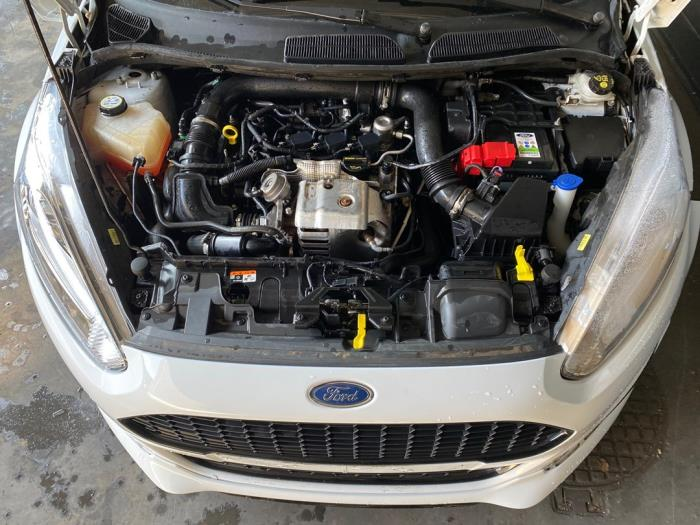
Technical Specifications:
- Oil viscosity: SAE 5W-20 (mandatory for EcoBoost)
- Oil capacity: 4.1 litres with filter change
- Required specification: Ford WSS-M2C948-B (EcoBoost-specific)
- Alternative specification: ACEA A5/B5 if WSS-M2C948-B unavailable (top-up only, max 0.5L)
- Power outputs: 100 HP (74 kW), 125 HP (92 kW), or 140 HP (103 kW)
- Torque: 170 Nm (125 lb-ft), up to 200 Nm with overboost
- Fuel type: 95 RON unleaded minimum (E10 compatible)
- Compression ratio: 10.0:1
- Engine codes: SFJA, SFJB, SFJC, SFJD, M1JA, M1JE
- Configuration: Inline 3-cylinder, turbocharged
- Features: Direct injection, wet timing belt, twin-scroll turbo, split cooling, Dual VVT
- Recommended oil: Castrol Magnatec Professional E 5W-20 (view on Amazon)
The Critical Importance of Ford WSS-M2C948-B Specification
Ford developed the WSS-M2C948-B specification specifically for EcoBoost engines, particularly addressing the wet timing belt’s requirements. This specification goes far beyond generic API or ACEA certifications:
Wet belt compatibility: The formulation prevents degradation of the timing belt material submerged in oil. Incorrect oils can cause the belt rubber to swell, crack, or delaminate, leading to catastrophic engine failure.
Low-temperature performance: The 5W-20 viscosity ensures instant oil flow to the turbocharger and timing system during cold starts, when most wear occurs.
Fuel economy optimisation: Ford calibrated engine management systems expecting this specific viscosity. Using thicker oil reduces fuel economy by 2-5% and may trigger fault codes.
Turbocharger protection: The formulation provides adequate film strength at the extreme temperatures and speeds experienced by turbocharger bearings (up to 200,000 RPM).
Direct injection compatibility: Special detergent packages help manage carbon deposits inherent to direct injection engines.
Critical warning: Many UK garages substitute 5W-30 oils meeting Ford WSS-M2C913-C (designed for older Ford engines). While this specification works for most Ford petrol engines, it is NOT approved for 1.0 EcoBoost engines with wet timing belts. The owner’s manual explicitly states 5W-30 can be used on other engines “except EcoBoost.” Using incorrect oil accelerates wet belt degradation and voids warranty coverage for timing-related failures.
Understanding the 5W-20 vs 5W-30 Debate
Significant confusion exists around oil viscosity for the 1.0 EcoBoost, partly because 5W-20 oils are less common in Europe than in North America. Some owners and even dealers incorrectly use 5W-30, reasoning that thicker oil provides better protection. This logic is fundamentally flawed for the 1.0 EcoBoost:
Why 5W-20 is mandatory:
- Wet belt protection: The WSS-M2C948-B 5W-20 formulation is specifically designed to be compatible with the timing belt material
- Oil pump design: The variable-displacement oil pump is calibrated for 5W-20 viscosity
- Fuel economy: Ford’s published MPG figures assume 5W-20 oil
- Cold-start protection: Thinner oil reaches the turbo and timing system faster in cold UK winters
What happens with 5W-30:
- Wet belt may degrade faster due to incompatible additive packages
- Slightly reduced fuel economy (2-5%)
- Potential warranty claim rejection if timing-related failure occurs
- No measurable improvement in protection (the engine was designed for 5W-20)
Finding WSS-M2C948-B oil in the UK:
- Castrol Magnatec Professional E 5W-20: The most common option, available at Halfords and motor factors
- Ford Motorcraft EcoBoost 5W-20: Available through Ford dealers
- Comma Xstream G30 5W-20: Budget-friendly option meeting the specification
- Millers Oils XF Premium 5W-20: Premium synthetic option
If WSS-M2C948-B oil is completely unavailable, Ford permits using up to 0.5L of ACEA A5/B5 5W-30 for top-ups only between services—never for complete oil changes.
Common 1.0 EcoBoost Problems and Oil-Related Prevention
While the 1.0 EcoBoost earned praise for innovation, it developed a reputation for certain issues. Many relate directly to oil maintenance:
Wet Timing Belt Degradation
Symptoms: Oil pressure warning light, rattling noise, engine entering limp mode
Cause: Belt material breaks down due to degraded oil, incorrect specification, or extended drain intervals. Fragments clog oil pump strainer.
Prevention:
- Use ONLY Ford WSS-M2C948-B 5W-20 oil
- Change oil every 12,500 miles maximum (many specialists recommend 7,500-10,000 miles)
- Never exceed oil change intervals
- Inspect wet belt condition during cambelt services
Cost of failure: Engine replacement typically £4,000-6,000
Ford originally claimed the wet belt was “lifetime,” but later revised recommendations to 150,000 miles or 10 years. Many specialists now recommend 100,000 miles or 8 years as a precautionary measure, particularly for vehicles used primarily for short trips.
Coolant Leaks and Head Gasket Issues
Symptoms: Coolant loss without visible leaks, overheating, white exhaust smoke
Cause: Early production engines (2012-2014) suffered from cooling system and head gasket weaknesses
Prevention: Monitor coolant levels regularly, address any losses immediately
Note: Ford extended warranty coverage for coolant-related issues on affected models
Carbon Buildup on Intake Valves
Symptoms: Rough idle, hesitation, reduced power, poor fuel economy
Cause: Direct injection doesn’t wash intake valves with fuel, allowing carbon accumulation
Prevention:
- Use quality 95+ RON fuel from major brands
- Occasional motorway driving at higher RPMs
- Consider intake cleaning every 50,000-60,000 miles
Turbocharger Issues
Symptoms: Whistling noise, loss of power, blue smoke
Cause: Oil starvation from clogged passages or incorrect viscosity
Prevention:
- Use correct 5W-20 oil allowing instant cold-start lubrication
- Allow engine to idle 30 seconds before shutdown after spirited driving
- Regular oil changes prevent varnish buildup in oil passages
Approved Oil Brands and Formulations
Only use oils explicitly meeting Ford WSS-M2C948-B specification:
Castrol Magnatec Professional E 5W-20: The most widely available option in the UK. Full synthetic meeting WSS-M2C948-B with Intelligent Molecules technology. Available at Halfords, EuroCarParts, and motor factors.
Ford Motorcraft EcoBoost 5W-20: Factory-branded oil guaranteeing specification compliance. Available through Ford dealers. Premium pricing but ensures warranty compliance.
Comma Xstream G30 5W-20: Budget-friendly full synthetic meeting WSS-M2C948-B. Widely available at UK motor factors.
Millers Oils XF Premium 5W-20: British-made premium synthetic meeting Ford specifications. Excellent choice for enthusiasts seeking maximum protection.
Fuchs Titan GT1 Flex 3 5W-20: German synthetic meeting multiple OEM specifications including Ford WSS-M2C948-B.
Mobil 1 ESP 5W-20: Premium synthetic available online, meeting Ford specifications.
Critical: Avoid oils only meeting Ford WSS-M2C913-C or generic ACEA A5/B5 specifications for oil changes. These are not formulated for the wet timing belt system. Always verify the Ford WSS-M2C948-B approval on the container.
Oil Change Intervals: Ford Recommendations vs Best Practice
Ford’s official service schedule recommends oil changes every 12,500 miles or 12 months for UK market Fiestas. However, given the wet timing belt’s sensitivity to oil condition, many specialists recommend more conservative intervals:
Recommended Practical Intervals
Normal driving (7,500-10,000 miles or 12 months):
This interval provides excellent wet belt protection while respecting modern synthetic capabilities. Most independent Ford specialists and enthusiast forums recommend 10,000-mile maximums for 1.0 EcoBoost engines. The modest additional cost of an extra oil change annually provides significant insurance against catastrophic wet belt failure.
Severe service (5,000-7,500 miles or 6 months):
Severe service includes:
- Predominantly short trips under 10 miles (common UK commuting patterns)
- Extensive stop-start urban driving
- Cold climate operation without adequate warm-up time
- Frequent cold starts without reaching full operating temperature
Short trips are particularly harmful to the 1.0 EcoBoost because the engine may never reach optimal temperature, allowing moisture and fuel to accumulate in the oil. This contamination accelerates wet belt degradation.
First oil change (3,000-5,000 miles):
Perform initial service earlier than Ford’s 12,500-mile recommendation to remove break-in particles and establish clean conditions for the wet belt.
Why Conservative Intervals Matter
The wet belt timing system transforms oil maintenance from “recommended” to “essential.” Unlike engines with timing chains that can tolerate occasional extended drains, the 1.0 EcoBoost’s belt material actively interacts with the oil. Degraded oil directly damages the belt, creating a cascade failure:
- Oil degrades beyond optimal condition
- Belt material begins breaking down
- Small rubber fragments enter oil circulation
- Oil pump strainer clogs with debris
- Oil pressure drops catastrophically
- Engine suffers bearing damage and potential seizure
This failure mode can occur without warning, often at motorway speeds. The cost-benefit analysis strongly favours frequent oil changes over risking engine replacement.
Wet Belt Service and Inspection
Given the 1.0 EcoBoost’s unique timing system, owners should understand wet belt maintenance:
Ford’s Current Recommendations
- Inspection: Check wet belt condition at every service
- Replacement interval: 150,000 miles or 10 years, whichever comes first
- Revised recommendation: Many Ford dealers now suggest 100,000 miles or 8 years as a precautionary measure
Independent Specialist Recommendations
Many independent specialists recommend:
- Visual inspection of belt condition every 50,000 miles
- Oil pump strainer inspection for debris
- Proactive replacement at 80,000-100,000 miles for vehicles predominantly used for short trips
- Immediate replacement if any belt material detected in drained oil
Wet Belt Service Cost
Complete wet belt replacement including tensioner, pulleys, oil pump drive belt, seals, oil and filter typically costs £400-600 at independent specialists, £600-900 at Ford dealers. This represents excellent insurance against £4,000+ engine replacement costs.
High-Mileage Considerations (80,000+ miles)
As 1.0 EcoBoost engines accumulate mileage, maintenance emphasis shifts:
- Continue WSS-M2C948-B 5W-20 exclusively—never switch to thicker viscosity
- Shorter intervals: 7,500 miles maximum regardless of driving conditions
- Wet belt inspection: Have belt condition assessed at every service
- Oil pump strainer: Request inspection during major services
- Carbon cleaning: Consider professional intake valve cleaning at 60,000-80,000 miles
- Turbo inspection: Listen for unusual whistling or rattling indicating bearing wear
Essential Maintenance Reminders
- Use ONLY Ford WSS-M2C948-B 5W-20 oil—wet belt survival depends on correct specification
- Never exceed 10,000 miles between changes—12,500 miles is too long for wet belt protection
- Check oil level monthly—turbo engines can consume some oil
- Replace oil filter at every change using Ford genuine or equivalent quality
- Perform first oil change at 3,000-5,000 miles to remove break-in particles
- Monitor coolant levels (2012-2014 models particularly prone to leaks)
- Allow warm-up before boost—protect turbo with 30-second idle before hard acceleration
- Plan wet belt replacement at 100,000 miles or 8 years as preventive maintenance
- Use quality 95+ RON fuel from major brands to minimise carbon buildup
- Keep detailed service records with oil brand and specification noted
Conclusion
The Ford Fiesta 1.0 EcoBoost represents groundbreaking engineering, delivering performance, efficiency, and driving enjoyment from a remarkably small package. Its award-winning design and excellent fuel economy make it an ideal choice for UK drivers. However, the innovative wet timing belt system transforms oil maintenance from routine into critical.
Success with the 1.0 EcoBoost requires absolute commitment to using Ford WSS-M2C948-B 5W-20 oil exclusively, maintaining conservative oil change intervals (7,500-10,000 miles maximum), and planning proactive wet belt replacement before failure occurs. Cutting corners on oil specification or extending drain intervals risks catastrophic engine failure—a £4,000-6,000 repair that dramatically exceeds the cost of proper maintenance.
With correct care, the 1.0 EcoBoost delivers exceptional service, combining efficiency that rivals hybrid vehicles with engaging driving dynamics. UK owners who understand and respect the wet belt’s requirements enjoy reliable, economical transportation backed by Ford’s engineering excellence. Those who ignore the specific maintenance demands may face expensive consequences.
The message is clear: for the 1.0 EcoBoost, proper oil isn’t just important—it’s everything.