
Best Engine Oil for Ford Focus Mk4 1.5 EcoBoost 150/182 HP
The Ford Focus Mk4 with the 1.5 EcoBoost “Dragon” three-cylinder turbocharged petrol engine (2018-present) represents Ford’s latest generation downsizing technology, delivering impressive fuel economy (5.3-5.5 L/100 km) with adequate performance for daily driving and motorway use. Available in 150 HP and 182 HP outputs, this innovative engine combines dual-injection technology (port + direct), cylinder deactivation for efficiency, and turbocharging for responsive performance. Understanding the correct oil specification (Ford WSS-M2C947-A/B1), managing carbon buildup from direct injection, and recognizing cylinder deactivation characteristics enables owners to maximize the reliable operation this modern engine delivers when properly maintained.
Quick Answer: Recommended Oil
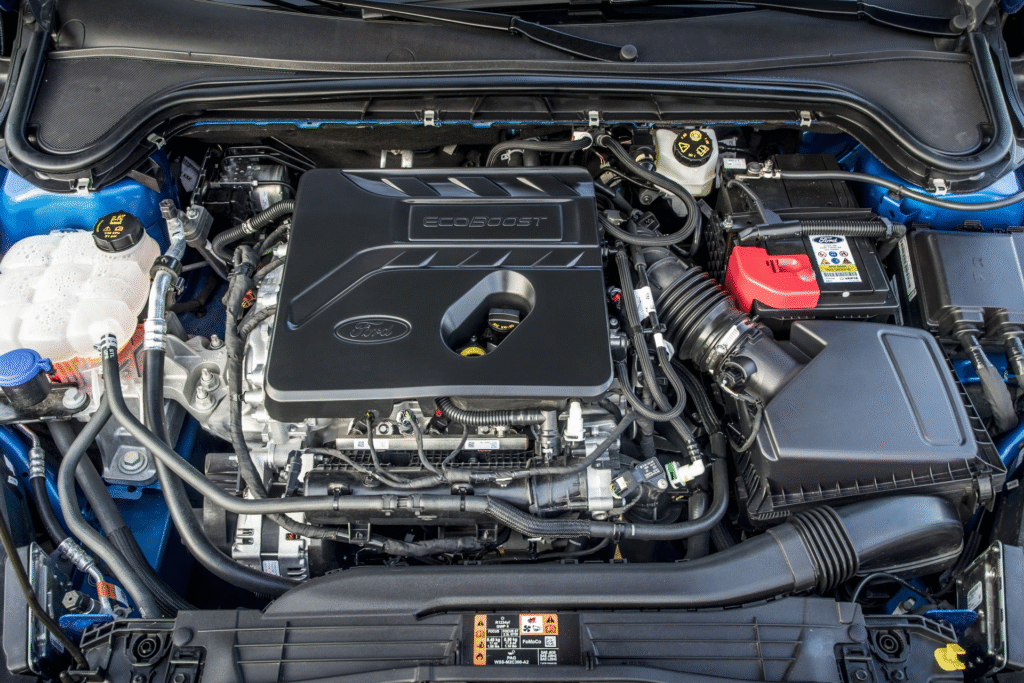
For Focus Mk4 1.5 EcoBoost (both variants):
- Required viscosity: SAE 5W-20 (mandatory for modern formulation)
- Ford specification: WSS-M2C947-A or WSS-M2C947-B1 (latest generation)
- ACEA specification: C5 (low-SAPS, ultra-low friction)
- Oil capacity: 4.75 liters with filter
- Recommended oils: Castrol Edge Professional Ford E 5W-20 (see on Amazon)
Key Advantage: The Focus Mk4 1.5 “Dragon” engine uses traditional timing chain (not wet belt like earlier 1.0 EcoBoost), eliminating the wet belt degradation concern. Correct Ford WSS-M2C947-A/B1 oil at 12,000-15,000 km intervals supports long-term reliability while managing carbon buildup typical of direct injection engines. Understanding cylinder deactivation operation and maintaining quality oil specification maximizes this efficient engine’s performance and longevity.
The 1.5 EcoBoost “Dragon” Engine
Introduced in 2018, the 1.5 EcoBoost “Dragon” represents Ford’s evolution of three-cylinder turbocharged technology. Based on the 1.0 EcoBoost architecture but with increased displacement to 1,497cc, this engine combines innovative dual-injection technology (both port and direct injection), cylinder deactivation capability, turbocharging, and traditional timing chain drive—addressing previous wet belt concerns while delivering class-leading efficiency.
Key Technologies: Dual-injection system combines port injection (cleaning intake valves) with direct injection (performance/efficiency), cylinder deactivation operates on two cylinders during light load (improves fuel economy), BorgWarner turbocharger with integrated wastegate provides responsive power delivery, timing chain drive eliminates wet belt degradation issues, Ti-VCT variable valve timing optimizes performance across rev range, gasoline particulate filter (GPF) meets Euro 6d emissions standards.
Design Philosophy: The “Dragon” name reflects Ford’s continued downsizing strategy—extracting maximum power from minimal displacement through advanced forced induction and electronic control while prioritizing real-world fuel economy through cylinder deactivation technology.
Technical Specifications by Power Output
1.5 EcoBoost 150 HP (110 kW):
- Engine code: YZDA, YZDB
- Production: 2018-present (Focus Mk4)
- Configuration: Inline-3, aluminum block, 12-valve DOHC
- Power: 150 HP (110 kW) @ 6,000 RPM
- Torque: 210 Nm (155 lb-ft) @ 1,750-4,500 RPM
- 0-100 km/h: 8.8 seconds
- Top speed: 210 km/h
- Fuel economy: 5.3-5.5 L/100 km combined
- CO2: 124-136 g/km
- Transmission: 6-speed manual or 8-speed automatic
1.5 EcoBoost 182 HP (134 kW):
- Engine code: YZDC, YZDD
- Production: 2018-present (Focus Mk4)
- Configuration: Inline-3, aluminum block, 12-valve DOHC
- Power: 182 HP (134 kW) @ 6,000 RPM
- Torque: 240 Nm (177 lb-ft) @ 1,750-4,500 RPM
- 0-100 km/h: 8.3 seconds
- Top speed: 222 km/h
- Fuel economy: 5.5 L/100 km combined
- CO2: 126-138 g/km
- Transmission: 6-speed manual
Oil Requirements (Both Variants):
- Viscosity: SAE 5W-20 only
- Specification: Ford WSS-M2C947-A or WSS-M2C947-B1
- Capacity: 4.75 liters with filter
- Filter: Motorcraft FL-2051-S or equivalent
- ACEA rating: C5 (ultra-low SAPS, low friction)
- Intervals: 12,000-15,000 km or annually
Both power variants share identical architecture—the 182 HP achieves higher output through ECU calibration providing increased turbocharger boost pressure and optimized fuel delivery. Maintenance requirements and oil specification remain identical across both outputs.
Understanding Cylinder Deactivation Technology
The 1.5 “Dragon” deactivates one of three cylinders during light-load conditions (cruising, gentle acceleration), running effectively as a two-cylinder unit. This reduces pumping losses, improving fuel economy by 5-10% during typical driving.
Activation Conditions: Engages when engine warmed (above 70°C), light throttle, 1,500-4,000 RPM, appropriate gear selection. Disengages immediately with increased throttle or acceleration.
Normal Characteristics: Some drivers notice subtle vibration changes or a “boom” sound when the third cylinder reactivates. Three-cylinder engines inherently produce more vibration than four or six-cylinder configurations—cylinder deactivation transitions make this more noticeable. This represents normal operation, not malfunction. The significant fuel economy benefit (5.3-5.5 L/100 km) justifies these minor characteristics.
Oil Specification: Ford WSS-M2C947-A/B1
Ford WSS-M2C947-A and B1 represent the newest petrol engine oil specifications, superseding earlier WSS-M2C948-B formulations. These meet stringent emissions requirements while supporting gasoline particulate filters, direct injection, turbocharging, and cylinder deactivation.
ACEA C5 Rating: Ultra-low SAPS formulation protects GPF from ash poisoning while providing adequate wear protection. C5 represents the latest low-SAPS category optimized for fuel economy and emissions.
5W-20 Viscosity: Ultra-low friction supporting Ford’s fuel economy targets. Provides improved cold-start flow, reduced internal friction supporting cylinder deactivation efficiency, optimal turbocharger bearing protection, compatibility with modern tight clearances. The combination contributes measurably to achieving 5.3-5.5 L/100 km combined fuel economy while ensuring GPF longevity throughout operational life.
Managing Carbon Buildup (Direct Injection)
Like all modern direct injection engines, the 1.5 “Dragon” experiences some carbon accumulation on intake valves. Direct injection sprays fuel directly into combustion chambers (not intake ports), eliminating the valve-cleaning effect of port injection.
Why It Occurs: Oil blow-by vapors recirculated through PCV contact intake valves where they bake into carbon deposits. Traditional port injection constantly washes valves—direct injection does not.
Dual-Injection Advantage: The 1.5 includes both port and direct injection. Port injectors activate during specific conditions (cold start, light load) providing valve cleaning not available on pure direct injection engines, significantly reducing carbon accumulation.
Timeline & Symptoms: Buildup typically becomes noticeable around 80,000-120,000 km. Symptoms include rough idle (particularly when cold), slight power loss, occasional misfires, increased fuel consumption. Many engines operate successfully beyond these mileages with minimal symptoms.
Prevention: Quality Ford WSS-M2C947 oil reduces blow-by, occasional high-RPM operation helps burn deposits, premium fuel provides benefit, regular oil changes minimize contamination. Professional walnut blasting (£300-500) effectively removes deposits if symptoms develop.
Top Oil Recommendations
Best Modern Specification: Castrol Edge Professional Ford E 5W-20
Latest Ford WSS-M2C947-A approved formulation specifically engineered for modern Ford petrol engines with GPF, turbocharging, and direct injection. Castrol’s Fluid Titanium technology provides enhanced film strength protecting turbocharger bearings under boost while ultra-low SAPS formulation protects particulate filter. Proven in Ford service networks. Cost: £48-62/5L.
Performance Choice: Mobil 1 ESP 5W-20
Advanced full synthetic meeting ACEA C5 with superior thermal stability for sustained motorway driving and the higher-stress 182 HP variant. Robust low-SAPS additive package supports GPF longevity while providing excellent turbocharger protection. Shear-stable viscosity maintains 5W-20 grade through extended 15,000 km intervals. Cost: £50-65/5L.
OEM Quality: Shell Helix Ultra Professional AF 5W-20
Ford WSS-M2C947-A approved offering proven GPF protection and direct injection engine cleanliness. Formulation used in Ford workshops globally. Adequate thermal stability and friction reduction for normal driving patterns across both power variants. Cost: £45-58/5L.
Value Quality: TotalEnergies Quartz 9000 Xtra Future 5W-20
ACEA C5 approved providing solid performance for 12,000-15,000 km intervals. Adequate GPF protection and friction reduction at mid-range pricing. Cost: £42-52/5L.
Oil Change Intervals
Ford Official: 15,000 km or 12 months
Recommended Practice: 12,000-15,000 km or annually
Why These Intervals Are Appropriate:
The Focus Mk4 1.5 “Dragon” with timing chain (not wet belt) allows normal service intervals without the shortened schedules required for earlier wet belt engines. The 12,000-15,000 km interval balances protection with economy while supporting GPF longevity through fresh low-SAPS oil.
Interval Considerations:
- Primarily urban driving (frequent short trips, stop-start): 12,000 km
- Mixed urban/motorway driving: 12,000-13,000 km
- Predominantly motorway use: 13,000-15,000 km
- Always annually regardless of mileage
Fresh oil maintains optimal GPF protection, supports turbocharger bearing longevity under boost conditions, minimizes carbon buildup through reduced blow-by, ensures cylinder deactivation system operates correctly, protects timing chain and tensioners.
Additional Maintenance & Characteristics
Timing Chain: Unlike earlier 1.0 EcoBoost wet belt engines, the 1.5 uses traditional timing chain lasting engine lifetime (200,000+ km), eliminating proactive service requirement and associated costs.
Turbocharger: Quality oil at appropriate intervals protects turbo bearings. Avoid aggressive driving immediately after cold starts—allow 30-60 seconds idle, several minutes before full boost.
Spark Plugs: Replace at 60,000-80,000 km using Ford-specified plugs. Premium plugs enhance cold-start and idle smoothness important for three-cylinder refinement.
Fuel Quality: Premium fuel (95+ RON) recommended, particularly for 182 HP variant. Enhanced detergents help minimize carbon accumulation.
Three-Cylinder Characteristics: Enhanced vibration at idle versus four-cylinder engines, subtle changes with cylinder deactivation transitions, audible engine note represent normal operation, not failures.
150 HP vs 182 HP: Choosing Your Variant
150 HP Characteristics: Adequate performance for daily driving (8.8s 0-100 km/h), excellent fuel economy (5.3 L/100 km), available with 6-speed manual or 8-speed automatic, lower insurance classification, ideal for urban-focused ownership.
182 HP Characteristics: Enhanced performance particularly motorway overtaking (8.3s 0-100 km/h, 222 km/h top speed), stronger mid-range torque (240 Nm vs 210 Nm), primarily 6-speed manual transmission, minimal fuel economy penalty (5.5 L/100 km), sportier character with minimal cost.
Maintenance Perspective: Both variants share identical service requirements—same oil specification, same intervals, same GPF and turbocharger considerations. The 182 HP experiences slightly higher thermal stress from increased boost making quality oil specification marginally more important, though both require Ford WSS-M2C947 exclusively.
Maximizing Focus Mk4 1.5 EcoBoost Longevity
Essential Maintenance:
- Ford WSS-M2C947-A/B1 oil at 12,000-15,000 km intervals
- Quality fuel (premium recommended for direct injection)
- Spark plug replacement 60,000-80,000 km
- Monitor for carbon buildup symptoms beyond 80,000 km
- Allow proper warm-up before aggressive driving (turbo protection)
- Recognize cylinder deactivation characteristics as normal operation
- Address any persistent rough idle or power loss promptly
Long-Term Reliability: The 1.5 “Dragon” benefits from lessons learned during earlier EcoBoost development. Timing chain eliminates wet belt concerns, dual-injection reduces carbon accumulation versus pure direct injection, modern GPF-compatible oil supports emissions system longevity. Many owners report smooth operation beyond 100,000 km when maintained with correct oil specification and appropriate service intervals.
Conclusion
The Ford Focus Mk4 1.5 EcoBoost (150/182 HP) requires Ford WSS-M2C947-A or WSS-M2C947-B1 approved SAE 5W-20 oil for GPF protection, turbocharger longevity, and optimal fuel economy.
Key Advantage: Timing chain design eliminates the wet belt degradation concern affecting earlier 1.0 EcoBoost models. Standard 12,000-15,000 km intervals prove adequate with quality oil specification.
Choose proven Ford WSS-M2C947 oils: Castrol Edge Professional Ford E, Mobil 1 ESP, Shell Helix Ultra Professional AF, or TotalEnergies Quartz 9000 Xtra Future. Verify Ford WSS-M2C947-A/B1 or ACEA C5 approval.
Understanding cylinder deactivation operation as normal efficiency technology rather than malfunction, recognizing typical three-cylinder characteristics, managing carbon buildup through quality fuel and occasional high-RPM operation, and maintaining correct oil specification enables reliable long-term ownership. The Focus Mk4 1.5 “Dragon” delivers impressive fuel economy (5.3-5.5 L/100 km) with adequate performance when its modern technologies are properly understood and maintained according to Ford’s specifications.